When Two Bra Measurements Give Different Results
Work through tape placement, unit mix-ups and rounding boundaries before deciding what a surprising G cup estimate means.
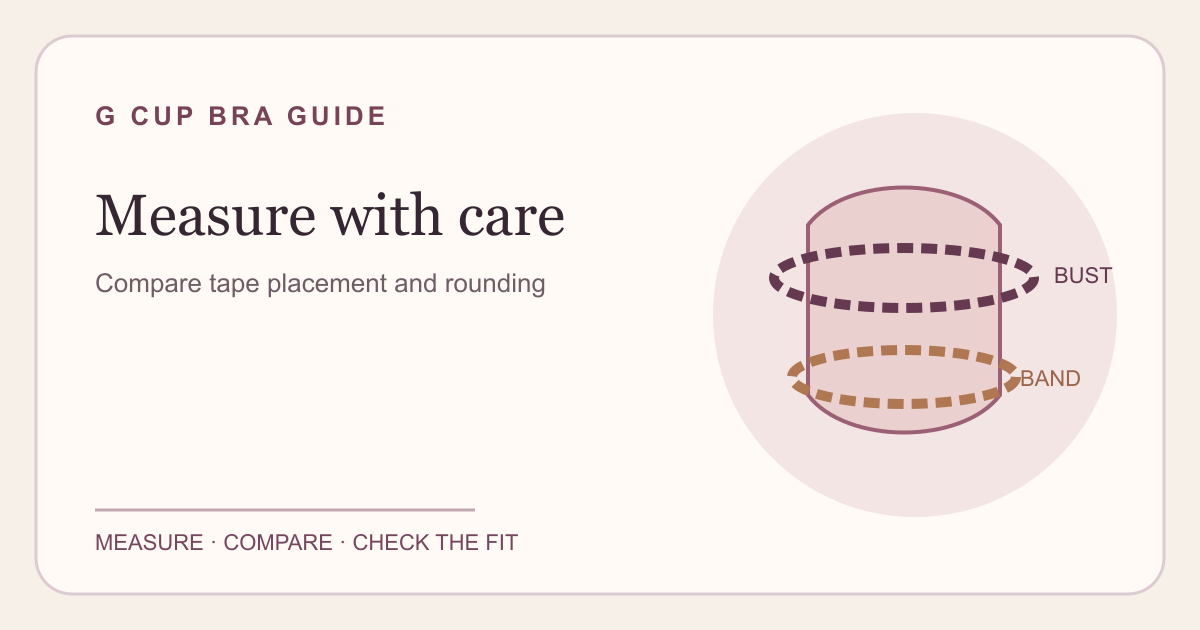
Your first measurement gives one starting size; the next attempt gives another. Before choosing between the labels, look at how the numbers were obtained. A difference in tape angle, tension or rounding can change a simplified estimate without representing a meaningful change in your body.
This guide uses our independent two-measurement method. It does not reproduce the six-measurement A Bra That Fits calculator, and its output is a starting point for a try-on.
Make the measurements comparable
Measure the snug underbust immediately below the breast tissue with the tape level around the ribcage. For the full bust, keep the tape in contact with the fullest point without compressing tissue. Check the side and back in a mirror. Use a natural posture and breathe normally.
Record the raw numbers with their units. Do not round to the size you expect before entering them. If two readings differ, check tape position and tension again rather than averaging them automatically. A diagonal tape and a level tape do not follow the same path.
Schematic comparison, not a body-shape prediction. Read the method.
Understand a rounding boundary
Our model rounds the underbust to the nearest even inch band, with exact odd-inch ties rounding upward. An underbust of 33 inches therefore gives a 34 band, while a value just below 33 gives 32. The label jumps in two-inch steps because those are the model’s band increments.
The next operation uses bust minus the rounded band, not necessarily bust minus the original underbust. For a 34-inch underbust and 43-inch bust, that is 43 − 34 = 9 inches: UK 34G and US 34I on our supported ladders. The same inputs in centimetres are 86.36 and 109.22. Switching units should not create a new physical size.
If you repeatedly measure near a boundary, both neighbouring bands can be informative try-on comparisons. The mathematical tie rule is transparent, but it cannot determine which garment tension you will prefer.
Schematic comparison, not a body-shape prediction. Read the method.
Use the first bra to learn more
Assess the band independently where possible. Then wear the cups normally, settle tissue inside and note where pressure or empty space appears. A cup that lacks depth can make the overall bra feel tight even when the band alone feels comfortable. Tightening the straps is unlikely to resolve that interaction.
Write a specific observation, such as “band stays level, cup edge gaps, wire slides down.” That record is more useful for the next choice than simply calling the calculated size wrong. If measurement alone keeps producing unhelpful results, a fuller measuring method or individual fitting can provide more context.
Schematic comparison, not a body-shape prediction. Read the method.
The step-by-step measuring guide covers placement in more detail. Enter your values in the homepage calculator to see both systems and the moving tape guide together.