
G Cup Sister Sizes Explained: Same Volume, Different Band
Change the band while keeping nominal cup capacity close — one band step and one cup step in opposite directions, inside one sizing system at a time.
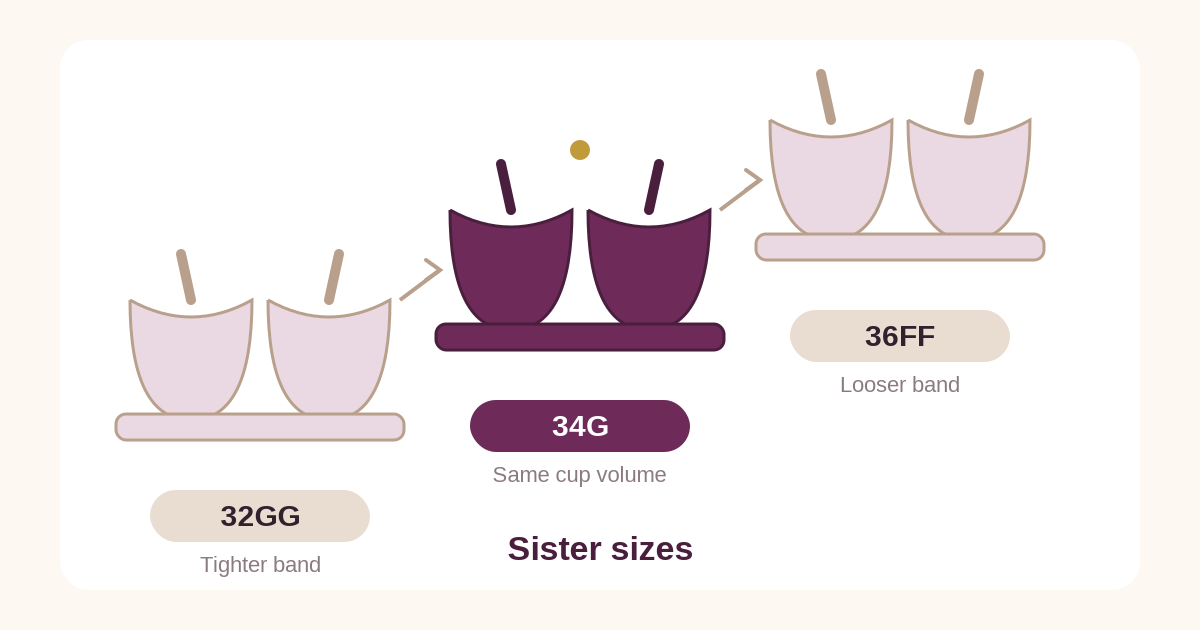
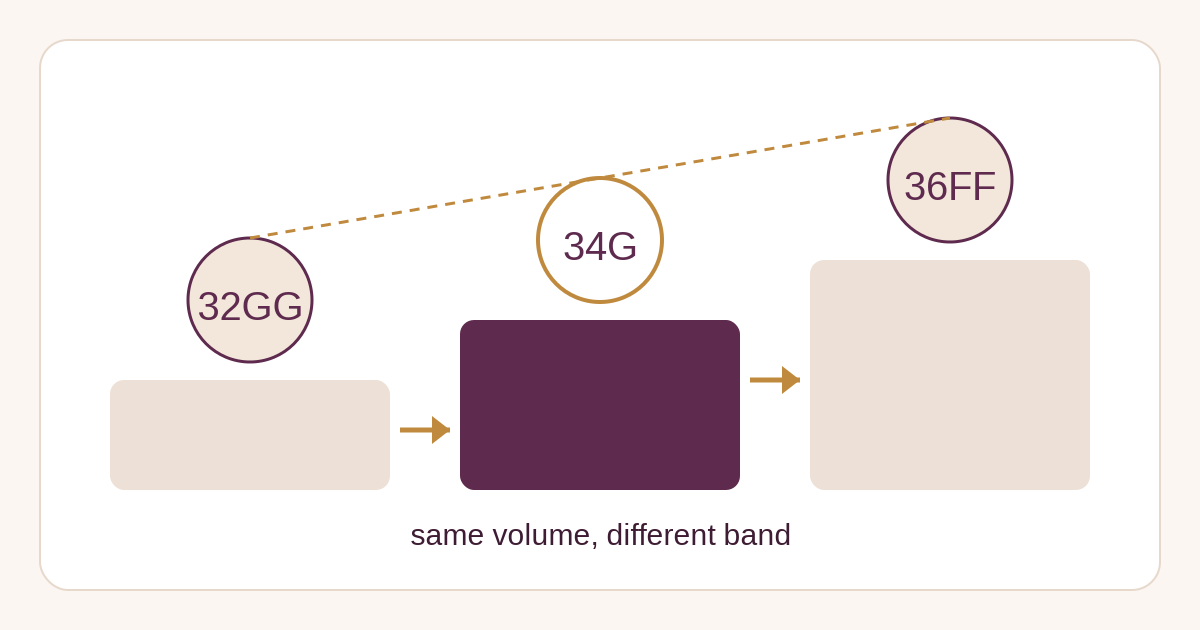
For UK 34G, adjacent sister sizes are 32GG and 36FF. For US 34G, they are 32H and 36DDD. Capacity lives in the pair, not the letter: move the band one step and the cup one step in the opposite direction. If you are also changing systems, convert first, then sister inside the new system — never stack both moves into one step.
Find your adjacent sister sizes
Starts with a labelled example. Change the inputs below to calculate your own comparison.
See the band and cup move in opposite directions
Changes with the inputs above. This is a garment and label diagram, not a body prediction.
Freya international size chart · Method and limitations. Size labels do not guarantee fit or stock availability.
| If you wear | Band too loose → try | Band too tight → try |
|---|---|---|
| UK 30G | 28GG | 32FF |
| UK 32G | 30GG | 34FF |
| UK 34G | 32GG | 36FF |
| UK 36G | 34GG | 38FF |
| UK 38G | 36GG | 40FF |
| UK 40G | 38GG | 42FF |
Why the letter moves
A cup letter is a difference, not a fixed volume: it is the bust measurement minus the band measurement. The same letter therefore holds more volume on a larger band and less on a smaller one — UK 34G, 32GG and 36FF are adjacent sisters because the band and the letter move in opposite directions to keep nominal cup capacity close.
That is why moving the band alone, keeping the same letter, changes two things at once: the frame and the volume. And it is why the sister move changes band and letter together. A sister move stays inside one system — UK sisters are not US sisters, so convert first if you are also changing systems, then sister inside the new system.
When sister sizing helps
Use it when the cups seem right but the band alone feels too loose or too tight. One smaller band takes one higher cup step; one larger band takes one lower cup step. A band that rides up points to the smaller-band comparison, and a band that digs on its own points to the larger-band comparison — but only when the cups already contain well. The result is a comparison to try on, not an identical fit: band tension, strap placement and wire width all change with the frame.
When to keep the band unchanged
If the band is comfortable and level but the cups spill, compare more cup capacity on that same band. If the cups gap while pressure remains elsewhere, investigate cup shape. A sister size is not the default solution to every fit problem: it answers a band question, not a cup-capacity or shape question.
Avoid long chains as a shopping shortcut
Several sister-size moves can dramatically alter strap position, wire shape and band support. A technically similar nominal cup capacity does not make every distant sister size wearable. Prefer an adjacent comparison and assess the whole garment. If your size is out of stock, record the full original label and try another model or range before treating a distant substitute as equivalent; if you do try an adjacent size, repeat the band, edge and movement checks.
Use fit evidence to choose the direction
Start from the band observation, not from the letter. Consider UK 34G with cups that contain the tissue well and a band that rides up. The adjacent 32GG comparison reduces the band while retaining similar nominal cup capacity. Choosing 32G instead would reduce the cup capacity as well, changing two fit dimensions at once.
If the 34 band feels too tight when tested independently, 36FF is the adjacent UK comparison. But if it only feels tight when the cups are worn normally, first consider inadequate cup depth or capacity. Increasing the band can disguise the original problem.
Why sister sizes can still look different
A larger frame can move straps farther apart or change how wires surround tissue. Two garments with similar nominal capacity may distribute that space differently. Judge containment and comfort after moving, not only while standing in front of a mirror. If the adjacent sister still fails on containment or comfort, the question is no longer the band — compare construction and shape next with the shape finder, rather than moving another band step away.
Use the diagram to follow the label arithmetic. Its identical bra icons intentionally do not promise identical dimensions or silhouettes. A label relationship is a starting comparison, not a physical specification: the same nominal capacity can sit differently on a different frame. When the question is which label is larger rather than which band fits, the size comparison tool keeps band and cup steps separate.
Follow one adjacent move in each system
For UK 34G, moving to band 32 requires the next cup step, GG, to retain similar nominal capacity. Moving to band 36 requires the previous step, FF. The complete adjacent comparisons are therefore 32GG and 36FF. In the US ladder, 34G instead leads to 32H and 36DDD. A step is the next label on that ladder, not the next letter of the alphabet — which is why the doubled steps (FF, GG, DDD) must be counted as steps in their own right.
Choose the direction based on a band observation. If the band is stable and comfortable but the cup spills, do not use a sister-size move as a substitute for adding cup capacity. If the band alone is too loose while cups contain well, an adjacent smaller-band comparison can isolate the question more effectively.
Why distant sister sizes are poor substitutes for missing stock
Moving several bands away can alter the frame substantially, and the frame is what carries support — so a distant move changes more than the label. Strap placement, wire shape and cup height need not remain suitable merely because a nominal capacity relationship can be calculated. The tool deliberately emphasises adjacent sizes so the output stays close to a realistic comparison task.
When a shop lacks your size, record the original full label and investigate another model or range before treating a distant substitute as equivalent. If you do try an adjacent size, repeat the band, edge and movement checks. The arithmetic preserves a grading relationship, not a promise that both bras will feel alike.
The band should remain comfortably level. If it rides up, assess tension independently of the cups before selecting another band.
34G — your starting point. A sister is a comparison to try, not an identical fit.
Sister sizes keep a similar nominal cup volume and change the band; the frame still changes, so confirm comfort in the actual garment.
Common questions
Where should I start with g cup sister size?
What does g cup sister size leave for an in-person try-on?
Sources & method
These named references informed the chart or fit guidance. Find publisher details and source locations in our source register. Worked examples use our documented independent method; they are not product tests or fit guarantees.
Found a chart mismatch or unclear explanation? Tell us which page and sizing system.