
When Two G Cup Bra Measurements Give Different Results
Work through tape placement, unit conversion and rounding boundaries before deciding what a surprising G cup bra size estimate means.
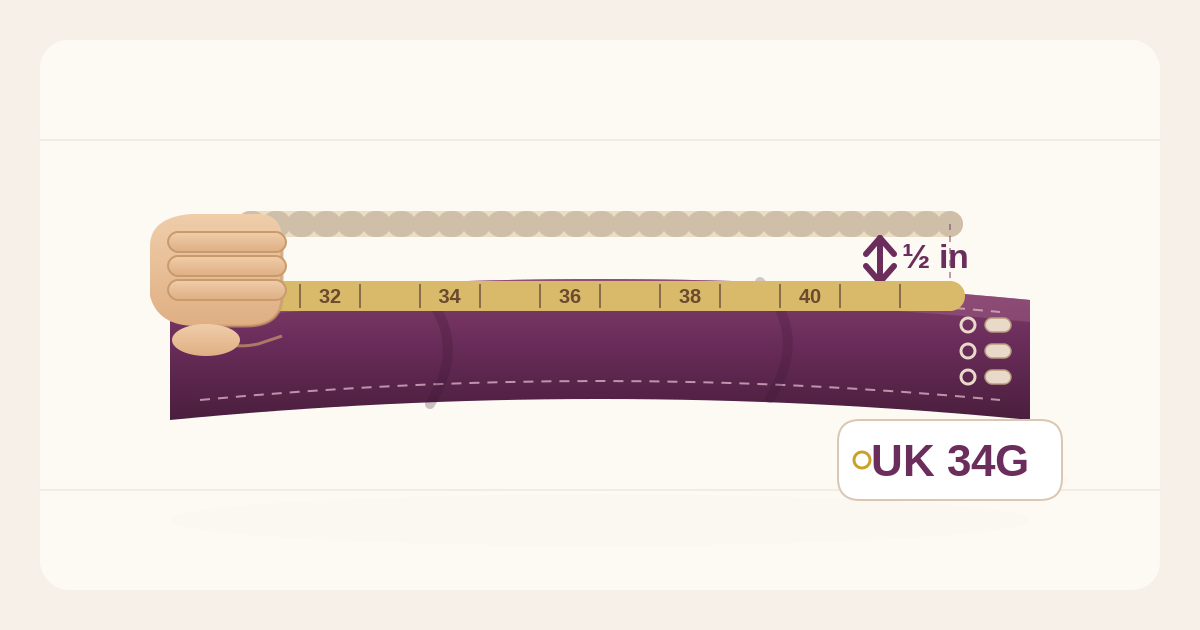
Your first measurement gives one starting size; the next attempt gives another. Before choosing between the labels, look at how the numbers were obtained. A difference in tape angle, tension or rounding can change a simplified estimate without representing a meaningful change in your body. Name the method before you compare the labels: two labels produced by two different tape paths, tensions or rounding rules are not two sizes of one body — they are two answers to two different questions, and only a note that records the method beside the numbers lets you tell which answer to trust.
This guide uses our independent two-measurement method. It does not reproduce the six-measurement A Bra That Fits calculator, and its output is a starting point for a try-on. Keep this post’s question separate from the calculator question: here the subject is why your own two measurements differ, not why two tools disagree.
First, a reassurance: two readings taken minutes apart can differ slightly — tape tension, posture and exactly where the tape sits all move the number — and that small variation is normal, not a flaw in the method. What matters is whether the readings agree on the band step, not whether they match to the quarter inch.
Make the measurements comparable
Measure the snug underbust immediately below the breast tissue with the tape level around the ribcage. For the full bust, keep the tape in contact with the fullest point without compressing tissue. Measure across the fuller side and fit the cup to the larger breast — the fit checker judges the larger side — rather than averaging the two sides into a middle reading that fits neither. Check the side and back in a mirror. Use a natural posture and breathe normally. Repeat the reading the same way before you conclude anything changed: same posture, same breathing, same tape path — a second reading taken a different way is a different measurement, not a confirmation.
Record the raw numbers with their units. Do not round to the size you expect before entering them. If two readings differ, check tape position and tension again rather than averaging them automatically. A diagonal tape and a level tape do not follow the same path. Do not average readings taken two different ways: averaging a diagonal reading and a level reading invents a third path that was never measured.
Understand a rounding boundary
Our model rounds the underbust to the nearest even inch band, with exact odd-inch ties rounding upward. An underbust of 33 inches therefore gives a 34 band, while a value just below 33 gives 32. The label jumps in two-inch steps because those are the model’s band increments. A half-inch slip matters most near a boundary: a reading that crosses 33 inches changes the band, and with it the whole label, even though the body has not changed by half an inch of fit.
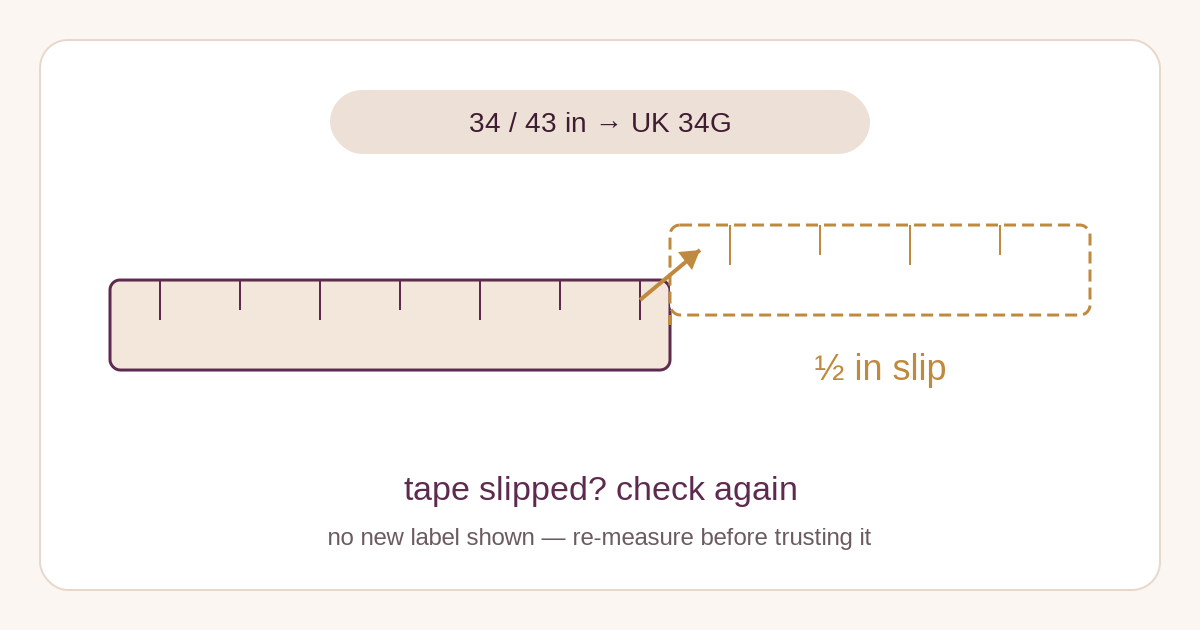
The next operation uses bust minus the rounded band, not necessarily bust minus the original underbust. For a 34-inch underbust and 43-inch bust, that is 43 − 34 = 9 inches: UK 34G and US 34I on our supported ladders. The same inputs in centimetres are 86.36 and 109.22. Switching units should not create a new physical size. Name the system with every label you compare: UK 34G and US 34I are the same 9-inch difference on the ladders used here, while a US G is a different, smaller cup — a G without its system is not a size at all. On DDDD charts the same 9-inch difference appears as US 34H, which is why the chart name belongs in the note too. A DDDD chart inserts a fourth D step before G, so every later letter shifts by one — the same 9-inch difference reads US H there instead of US I.
If you repeatedly measure near a boundary, both neighbouring bands can be informative try-on comparisons. The mathematical tie rule is transparent, but it cannot determine which garment tension you will prefer. Compare neighbouring bands as sister sizes, not as the same letter on a different band: 32GG, 34G and 36FF share the volume, so keeping the letter while changing the band changes the cup you are actually trying.
Use the first bra to learn more
Assess the band independently where possible. Then wear the cups normally, settle tissue inside and note where pressure or empty space appears. A cup that lacks depth can make the overall bra feel tight even when the band alone feels comfortable. Tightening the straps is unlikely to resolve that interaction. Judge in band-first order: band level first, then cup containment, then wire position, and straps last — tightening straps to rescue a loose band only hides the band question.
Write a specific observation, such as “band stays level, cup edge gaps, wire slides down.” That record is more useful for the next choice than simply calling the calculated size wrong. Record the full label — band, letter and system — with the observation, so the note still means the same thing when you compare the next bra. If measurement alone keeps producing unhelpful results, a fuller measuring method or individual fitting can provide more context.
The step-by-step measuring guide covers placement in more detail. Enter your values in the homepage calculator to see both systems and the moving tape guide together. If two readings differ by one band step, try both neighbouring bands rather than splitting the difference into a band no garment is made in.