
G Cup Bras for Small Bands: Fit and Shopping Guide
Find a G cup bra for a smaller band. Compare UK and US labels, wire width, cup depth and returns without sacrificing a secure underband. Read every label as band, letter and system together.
Shop by the complete size and its sizing system. A fuller cup on a smaller band needs a stable underband and compatible cup depth; moving up a band just to find stock can leave the bra unstable. A smaller band with the same letter holds a smaller nominal capacity: 28G is not the same cup as 34G, and a sister size changes the band while holding capacity close — it does not make one band equal to another.
Start with the band you actually need
A small clothing size does not establish your bra band. Take a snug underbust measurement, then use a starting-size estimate and check the garment. The band should remain level when you lift your arms, without painful pressure. If the cups pull the band forward or distort the wire, assess cup capacity and shape before deciding the band is too small. Judge the band first, on the loosest hook and after movement — raise your arms and sit — before you change the cup letter.
Retailers use different definitions of a small band. Search your full label, such as UK 28G or 30G, rather than a petite category alone. Petite can describe torso length or clothing proportions; it does not guarantee fuller-cup availability. A retailer that lists “small band” without a band number has told you nothing about the band: the number is the search term, not the category. For larger bands, the large-band guide reads the number and letter together.
Keep UK and US G separate
On the Freya chart used by this site, UK G converts to US I; US G converts to UK F. Confirm whether the retailer displays the maker’s original label or converts it for the local market. A search result containing “G cup” does not establish that the offered model matches your size. Record the system with every label you save: “30G” without UK or US is incomplete.
For example, UK 30G has approximate sister sizes UK 28GG and 32FF. US 30G instead steps to US 28H or 32DDD on the supported sequence. These are capacity comparisons, not interchangeable fitting recommendations. A larger sister band may move even when the cup capacity is close. Sister sizing moves band and letter in opposite directions, and each step changes the frame the cup sits on — it is a comparison to try on, not an identical fit.
Check projection and wire position
A cup can look roomy at the top while being too shallow at the base. If the wire slips below the breast fold or the neckline gaps alongside lower-cup pressure, compare a different cup shape. A seamed cup can be a useful reference against a firm moulded cup; neither construction is universally better. Read depth at the base, edge at the top and wire at the side as separate observations: one observation must not be used to infer the other two.
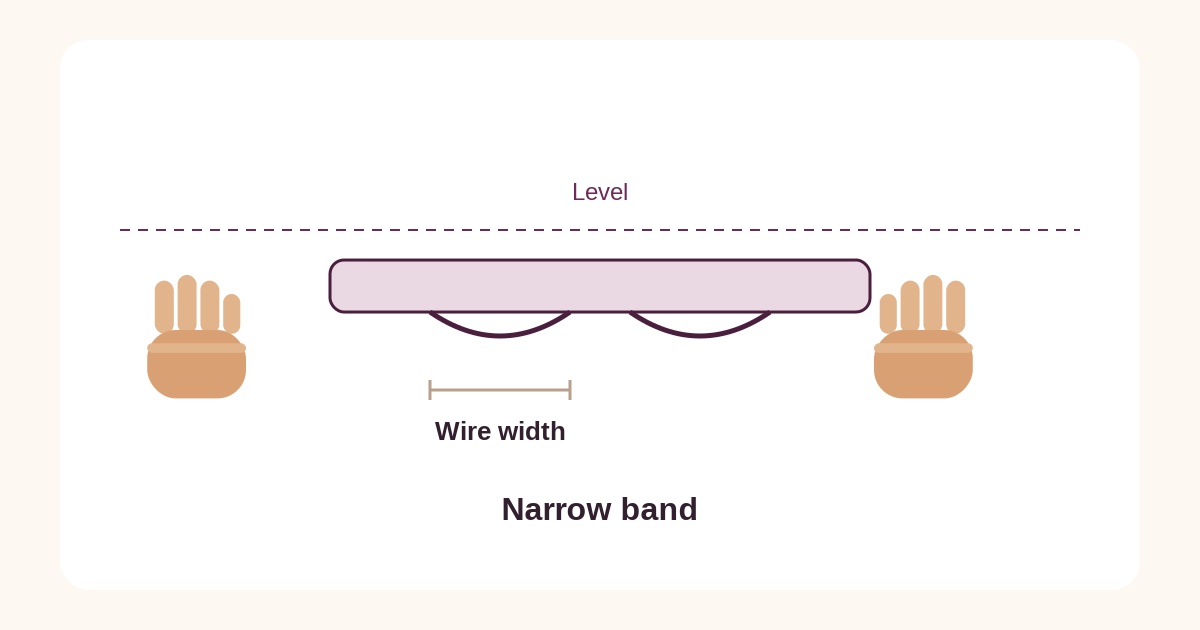
Wire width is not determined by a cup letter alone. Check whether the wire surrounds tissue without resting on it, then inspect the outer edge near your arm. Tightening straps to lift a descending cup can disguise a shape mismatch and increase shoulder pressure. That outer-edge check matters more on a small band, where a wide wire can sit on tissue even when the cup capacity is right.
Make a short, returnable comparison
Choose one model in your starting size and, if the returns policy permits, one adjacent cup in the same band. This isolates cup capacity more clearly than ordering unrelated styles in several sister sizes. Record the model, original label, band stability and wire position after sitting and reaching. Change one thing at a time — same model, adjacent cup, same band — because changing model and size together hides which change mattered.
Ask the shop about full-size stock, fitting assistance, return postage and whether tags must stay attached. An extender can temporarily change band tension, but it does not add cup depth or change the wire shape. Keep a comfortable current option while you compare. For changing comfort needs, the nursing and maternity guide separates access from cup comfort.
Small-band G cup availability and fit checks
A small band with a G cup is a narrower availability range than a mid band, so check the exact band-and-cup combination — band, letter and system — rather than a brand-wide cup range. A brand that stocks G cups may still not stock your band. A sister size such as 34FF for a UK 32G keeps a similar cup volume but gives a looser band, so it is a compromise when the exact band is unavailable, not an identical fit.
Check wire width against your root width and strap placement against shoulder slope, because a small band can pull straps inward or let a wide wire sit on tissue. Make a short, returnable comparison of two nearby sizes or constructions rather than ordering several sizes at once without a returns plan. Note strap placement after movement, not just standing still: a small band can pull straps inward once you reach.
Common questions
Can I buy a bigger band to find a G cup in stock?
Is UK 30G the same as US 30G?
Sources and scope
Manufacturer charts establish label sequences; fitting resources support garment checks. Construction comparisons are practical guidance, not wear-test results or certified fitting advice.
See the source register, authorship and research standards and calculator method. If something needs correcting, contact us to report a correction.