
Minimizer or Full Coverage at G Cup?
A minimizer and a full-coverage bra start from the same size and change different things. Learn what each style redistributes, covers and cannot do.
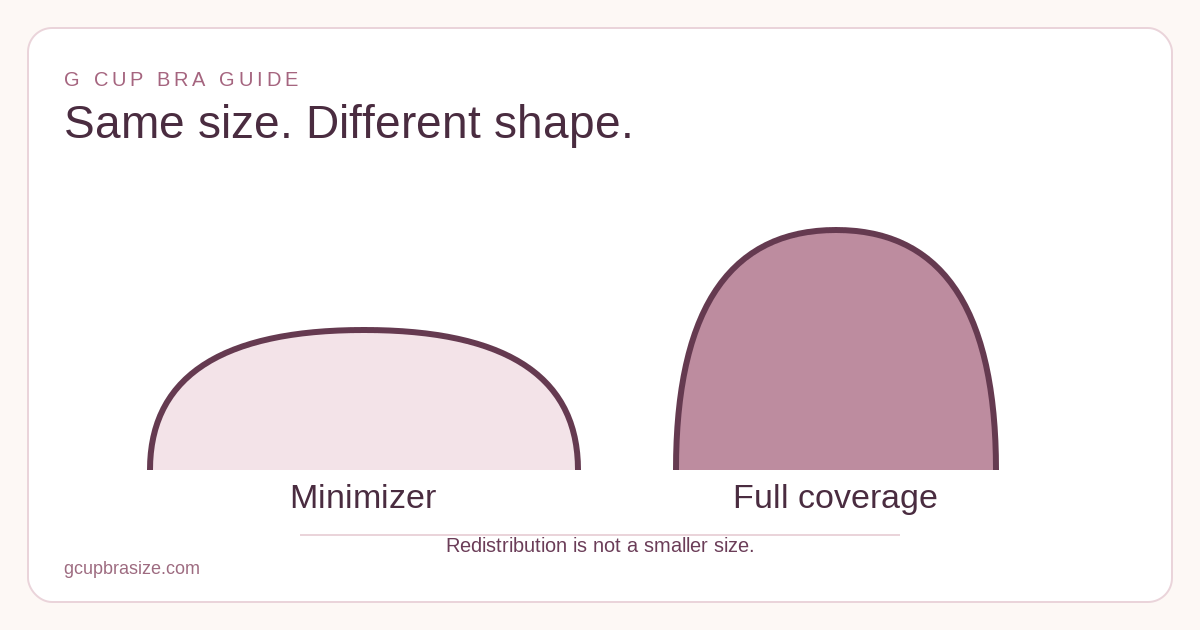
A minimizer and a full-coverage bra start from the same place: your measured label, band and system together. Neither one changes your size. What each one changes is where tissue sits inside the garment, how much of the bust the cup covers, and what the result looks like under clothing.
That shared starting point matters, because it stops a style comparison from turning into a size argument. If you try both from the same starting size and keep the band stable, the difference you record belongs to the construction — and that difference is what should decide the choice.
What a minimizer changes
A minimizer changes the supported outline through its construction. It redistributes tissue within the garment — spreading it a little wider and flatter — so the front profile under a shirt looks less projected. The shirt placket may close more easily, and a fitted top may drape more smoothly.
What a minimizer does not do is just as important. It does not reduce your size, your tissue or your volume. A smaller letter is not the result, and this guide gives no reduction figure in inches or centimetres: any such number would be a claim about a specific garment, and no single figure holds across models. Judge a minimizer by where the tissue sits — front and sides — and whether the wire still surrounds it comfortably, not by a smaller letter.
The trade-off is at the sides and the wire. Tissue moved outward still needs room and a wire that surrounds it without pressing. If the shirt closes but the wire presses, or breathing feels restricted, the clothing result does not establish a good fit. Comfort and containment still have to pass their own checks.
What full coverage changes
A full-coverage cup has a higher top edge and covers more of the bust than a balconette or plunge. In a G cup, that extra coverage contains the upper bust more completely, which helps when tissue escapes at the top edge of a lower cut or when you want containment through movement rather than a particular neckline.
The trade-off is the neckline itself. A higher cup can contain well and still show above a low neckline, and a cup that holds standing still can behave differently once you sit, lean or reach. Full coverage answers a containment question; it does not automatically answer an outfit question. Test both together when the outfit matters.
Full coverage also does not change your size. The cup is taller and more enclosing, but the starting label is the same, and the band-first order still applies: a full-coverage cup on a loose band will still ride up, and no amount of coverage fixes a band that does not hold.
What a minimizer is not
A minimizer is not a sports bra — a sports bra compresses flat, a minimizer redistributes without flattening. And a minimizer is not a full-coverage bra — full coverage contains and supports without changing the front profile. The two styles answer different questions, so a garment that does one job well is not failing at the other.
Fit checks for a minimizer
Button the actual shirt, then sit and reach forward. Check the shirt placket and the bra beneath it as two separate verdicts: a shirt that closes is not proof of a good fit, and a bra that fits is not proof the shirt will close. Check both, seated and reaching as well as standing, because a silhouette that holds still and fails in movement is not a settled fit.
Then check the wire and the sides. The wire should surround the tissue without pressing, breathing should feel unrestricted, and the sides should feel supported rather than squeezed. If any of those fail, compare a different construction or a different complete size based on the observed problem — not a smaller letter chosen for the silhouette alone.
Fit checks for a full-coverage bra
Check the top edge first, in the outfit you will actually wear. Does the cup contain the upper bust without gaping when you lean, and does it stay below the neckline you need? A gap at the top edge and pressure at the cup base are two separate observations: the first points to neckline or cup height, the second to depth or capacity.
Then check the wire and the band as usual. The wire should sit in the crease, the band should stay level, and the cups should contain without spilling at the sides. A taller cup can hide a band problem for a while, because the extra fabric holds tissue that the band should be anchoring — so judge the band independently, with the cups out of the way, before calling the fit good.
Choosing between them
Ask which question you are answering. If the question is the outfit — a shirt that must close, a smooth line under a fitted top — a minimizer is the construction to compare. If the question is containment — tissue escaping at the top edge, a need for coverage through movement — full coverage is the construction to compare. If both questions matter, test both constructions from the same starting size and record which problem each one actually solved.
| If you want… | Choose | Why |
|---|---|---|
| No button-gap under a shirt | Minimizer | Redistributes tissue so the placket closes |
| No spillage + smooth containment through movement | Full coverage | Taller, deeper cup contains the upper bust |
| A sleeker front under a fitted top | Minimizer | Less forward projection |
| Coverage that holds while sitting and reaching | Full coverage | Containment, not silhouette |
As outfits, not guarantees: a minimizer for button-down shirts, formal tops and fitted tops; full coverage for daily wear, long workdays and travel — the outfit is what the choice serves, not a promise about any garment.
Measure with the how-to-measure guide, use the fit checker to turn one observation into one next comparison, and see the minimizer guide for the full minimizer checklist. The same size, two different shapes — and the right one is the one that passes its own checks.