
Wired or Wireless G Cup Bra? How to Choose
A wire and a wireless band hold a G cup in different ways. Compare construction, fit checks and starting sizes before choosing between them.
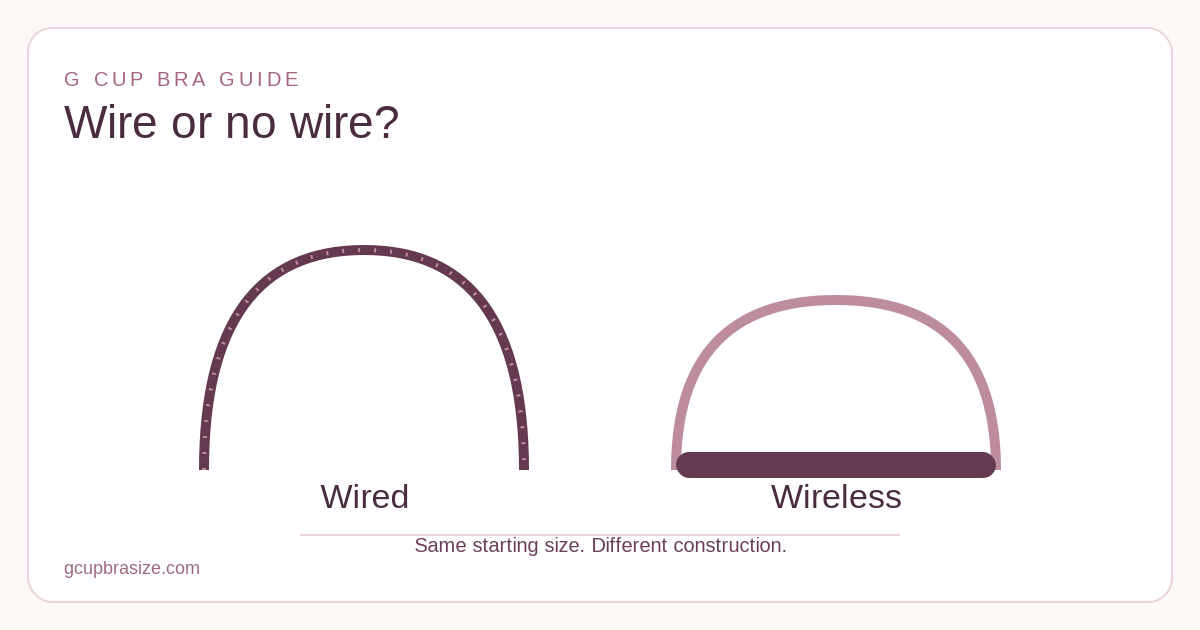
A wired bra and a wireless bra can share the same starting size and still behave differently. The label does not change between them: a UK 34G is still a 34 band with a 9-inch difference on the chart used here. What changes is how the garment carries that label — where the support comes from, what moves first when the fit is wrong, and which check tells you the most.
That is why construction is worth comparing before size. If a wired bra fails and a wireless bra succeeds (or the reverse), the lesson may be about construction, not about your measurements. Keep the band while you compare, so the difference you record belongs to the garment.
What a wire does
A wire is a shaped frame at the base of the cup. It surrounds the breast tissue, anchors the cup to the band, and helps the cup hold its shape. In a G cup, that frame does two jobs that are easy to confuse: it defines where the cup ends, and it keeps the cup from collapsing under the tissue it contains.
The wire check is therefore a position check, not a comfort contest. The wire should sit in the crease beneath the tissue, following it without pressing into tissue at the sides or the centre. A wire that sits on tissue, digs at the ends, or deforms out of shape is a fit observation — it points to wire width, cup depth or band stability, not automatically to a different letter.
A wire does not fix a band problem. If the band rides up, the wire rides with it, and the cup loses its anchor. Judge the band first, then the wire: a stable band with a misplaced wire is a different comparison from a loose band with a well-placed wire.
What wireless does
A wireless bra carries the same job without the frame. Fabric panels, seams and the band itself distribute the tension, and the lower edge of the band becomes the main anchor. That makes the seated check especially informative: a wireless band can feel fine standing still and roll, fold or ride up once you sit, because the torso bends where the band sits.
The centre of a wireless bra behaves differently too. Without a wire to tack flat, the centre may float slightly without that being a failure on its own. Judge a wireless bra by containment and comfort — does tissue stay inside the cups, does the lower edge stay in place, does the band stay level — rather than by asking it to imitate a wired bra.
Comfort is a real comparison here, not a consolation. A wireless style can suit long days, lounging, sensitive periods and anyone who finds wires irritating. But comfort alone does not settle the fit: a comfortable wireless bra that lets tissue escape underneath has a containment problem, not a comfort success.
When each tends to hold
Wired construction tends to suit structured separation and a defined cup shape, and outfits where the cup edge must stay exactly where it was put. Wireless construction tends to suit flexibility, softer edges and days when comfort matters more than structure.
Those are tendencies to compare, not promises. A well-made wireless bra can contain firmly, and a poorly fitted wired bra can gap, dig and shift. The garment, the band and the cup shape decide — the category word alone does not.
Four questions before you choose
Ask these four questions before the fit checks — there is no score, the answers point at the construction to compare first:
- Do you need the cup edge to stay exactly where it was put (wired tendency), or soft edges and flexibility (wireless tendency)?
- Is the priority separation and a defined shape, or comfort over a long day?
- Does the band stay level on its own, or does it need the wire’s frame to hold the cup shape?
- Is this for a structured outfit, or for lounging and sensitive days?
The row to remember is fit tolerance. A wireless bra can fit adequately even when it is slightly off; a wired bra needs the wire to sit exactly around the tissue to feel good — so a wired try-on is judged on the wire position first, and a wireless try-on on the band first.
The priority rule follows from that. For a wired bra the cup is the priority — the wire must enclose the tissue completely. For a wireless bra the band is the priority — with no wire to hold the cup shape, a snug level band does more of the work.
Fit checks for a wired bra
Work in the band-first order. Fasten a new band on a comfortable setting, then check the wire before the straps. The wire should follow the crease, sit flat against the ribcage between the cups, and keep its shape when you move. Reach overhead, twist and sit: if the wire slides downward or presses harder, check whether the band moved first.
Then check the cups with tissue settled inside. Spillage at the top edge, gaping when you lean, or tissue escaping at the sides each point to a different comparison — cup depth, neckline or wire width — so record the location rather than treating every problem as a size problem.
Fit checks for a wireless bra
Start seated. Sit, lean and reach, and watch the lower edge: has it stayed in place, rolled onto itself, or moved upward? A broad band can feel comfortable on one torso and fold at a natural bend on another, so width alone is not a verdict — compare depth and flexibility at the point where your torso bends.
Then check containment: tissue escaping underneath while the straps feel tight points to the band or the lower edge, not to tighter straps. Loosening or tightening the straps alone rarely solves a lower-edge problem. If containment and comfort are both good, a floating centre is not a reason to abandon the style.
The starting size stays the same
Whichever construction you compare, start from the same measured label. Measure with the how-to-measure guide, take that starting size into both try-ons, and change one thing at a time. If the wired version gaps and the wireless version contains, you have learned something about construction. If both fail in the same place — the band rides up in both, or both spill at the same edge — the next comparison is more likely about size or shape than about wires.
Use the fit checker to turn one observation into one next comparison, and the wireless guide for the full wireless checklist. A label is a starting point, not a verdict, and construction is one of the comparisons that makes that starting point useful.