
F vs FF vs G Cup: What Changes at Each Step?
F, FF and G are neighbours on the UK cup ladder, one inch apart. See what changes at each step on the same band, and why the US letter G is a different size.
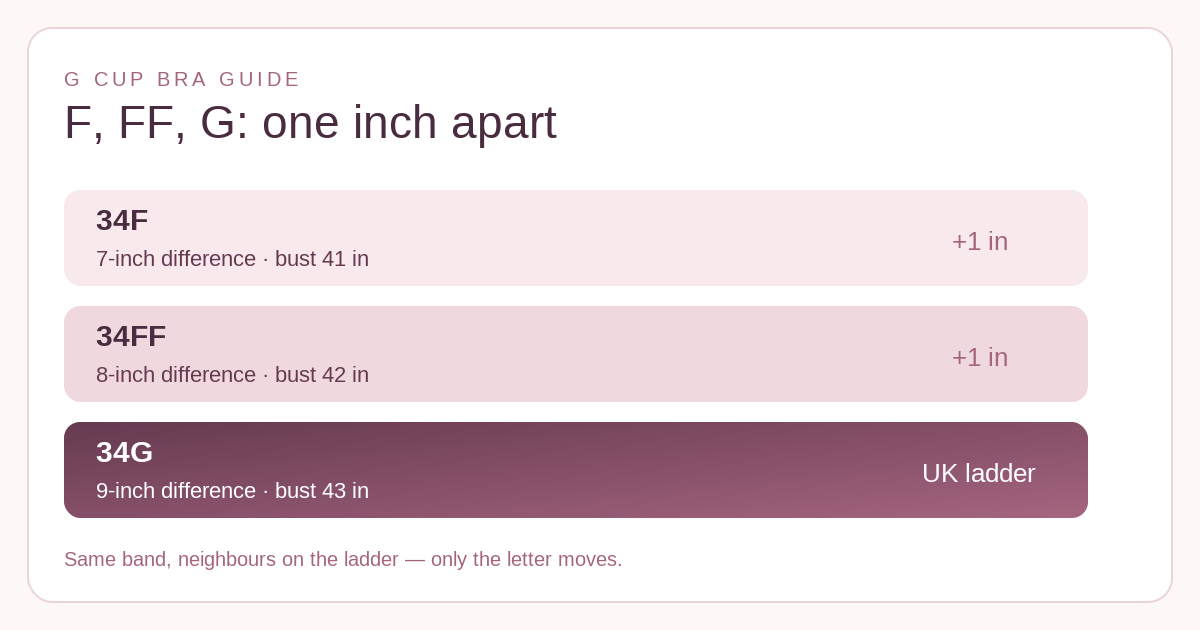
If you have ever wondered whether F, FF and G are far apart or close together, the short answer is simple: on the UK ladder they are neighbours, one inch apart. Each step up the ladder adds one inch to the difference between your bust and your band. Nothing else about the size changes at that step — the band stays the same, and only the cup letter moves.
That one-inch rule is the whole story of this post. Once you see it worked through on a single band, the letters stop looking mysterious, and the difference between UK and US labels becomes much easier to spot.
The short answer: one inch per step
In UK sizing, the cup letters run in a sequence, and each letter stands for a bust-to-band difference. Around G, the sequence runs E, then F, then FF, then G, then GG. F means a 7-inch difference, FF means 8 inches, and G means 9 inches. So moving from F to FF adds one inch, and moving from FF to G adds one inch again.
This is why the letters are not grades of size in the way clothing sizes sometimes feel. They are steps on a measuring scale, and every step is the same size: one inch. One inch of difference at each step — but the volume that inch adds grows as the cup gets bigger, so the step from G to GG adds more volume than the step from B to C.
Same band, three cups: 34F, 34FF and 34G
Take one band, 34, and hold it still while the cup changes. The three sizes below all share that band, so the only thing that differs is the bust measurement:
- 34F — a 7-inch difference, so a bust of 41 inches on a 34 band.
- 34FF — an 8-inch difference, so a bust of 42 inches on a 34 band.
- 34G — a 9-inch difference, so a bust of 43 inches on a 34 band.
Read across that row and the pattern is plain: same band, bust rising by one inch at each step, letter moving one step at a time. If your bust measures 42 inches on a 34 band, you are at the FF step, not the F step and not the G step. The letter follows the measurement; the measurement does not follow the letter.
The try-on gives you the deciding symptom for each step. Tissue spilling over the top edge (quad-boob) that stays once the band is settled points a step up — try the next letter before changing the band. Gaping at the top edge while the band is settled points the other way — try a step down with a smaller band. The symptoms already exist on the fit pages; this post attaches them to the ladder steps, and it adds no new sizing rule.
It also works the other way. If you know your size is 34G, you know your bust sits 9 inches above your band. That is a useful check when a size feels off: compare the two measurements behind the label before blaming the letter.
Why FF exists: smaller steps between cups
You may have noticed that the sequence uses double letters — FF sits between F and G, and GG sits after G. The reason is practical: single letters alone would leave gaps of more than one inch between some steps, and a one-inch step is a finer, more useful measure than a jump of two or three inches.
Double letters are not a separate kind of cup. FF is simply the step between F and G, the same way GG is the step after G. FF is not halfway between F and G — each doubled letter is one full inch step. If a chart you are reading skips FF and jumps straight from F to G, it is using a different ladder — and that is worth noticing, because it changes what the letter G means on that chart. On a ladder that includes FF, G is a 9-inch difference; on a ladder that skips FF and jumps F to G, G is an 8-inch difference — the same letter, a different definition, which is why the chart’s ladder must be named before the letter is read. Which brings us to the US labels.
Where US labels differ: the same letter, a different size
Here is the point where most confusion starts. A US G is not the same size as a UK G. In US sizing, G stands for a 7-inch difference — the same difference as a UK F. A UK G, at 9 inches, sits two steps higher on the same band.
So UK 34G is usually US 34I on common US charts. The letter changes because the ladders count differently after DD: the UK ladder inserts double letters, while the common US ladder does not, so the two systems arrive at different letters for the same measurements.
There is one variant to watch for. On US charts that use a DDDD step, the same UK 34G lines up with US 34H instead of US 34I. Neither alignment is wrong on its own chart — but they are different labels, so reading the chart in front of you matters more than memorising one conversion. If the chart you are using disagrees with a general conversion, the chart in front of you wins.
A different move: sister sizes change the band, not the system
Sister sizes are easy to mix up with conversion, but they are a different idea entirely. Conversion changes the labelling system while the measurements stay the same. Sister sizing keeps the cup volume the same while the band changes.
For UK 34G, the sister sizes are 32GG and 36FF: a smaller band with a cup letter stepped up, or a larger band with a cup letter stepped down. The volume stays roughly the same because the band and the cup move in opposite directions.
The distinction matters when you are choosing what to try. If a chart is in a different system, you convert the label. If the band does not sit right but the cup volume feels right, you look at a sister size. Doing one when you meant the other is a common source of sizes that feel wrong for no obvious reason.
Before you order: check the system, start from the band
Two checks, in this order, will save you most mistakes:
- Check which system the chart uses. Look at what follows DD on the chart itself — DDD means US labels, E means UK labels. If the chart uses a DDDD step, remember that UK 34G lines up with US 34H there, not US 34I.
- Start from the band. Your band is your underbust rounded to the nearest even inch, with nothing added. Once the band is right, the cup letter follows from the bust-minus-band difference, one inch per step.
F, FF and G are not three distant sizes. They are three neighbouring steps, one inch apart, on a ladder that only makes sense once you know which system you are reading. Get the system and the band right first, and the letter takes care of itself.