Shopping for UK 34G on a US Storefront: A Worked Example
Follow a UK 34G label through a US product selector, distinguish conversion from sister sizing, and check the garment when it arrives.
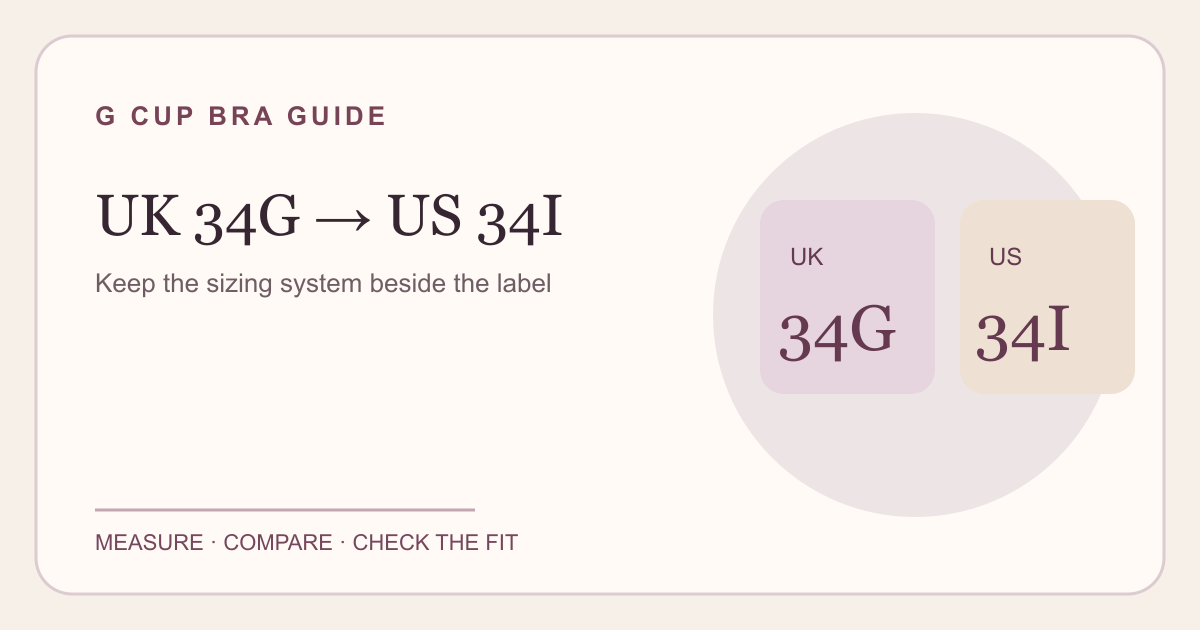
You have a comfortable bra labelled 34G UK. A US shop offers the same brand and displays a G option. It is tempting to select it and move on, but one question changes the order: has the shop converted the sizes into US labels, or is it displaying the brand’s UK labels?
This worked example follows the Freya international chart. It is a label comparison, not a claim that every brand grades its garments identically.
First, identify the selector’s system
Read the size guide attached to the specific product. A UK brand sold in the United States does not necessarily appear under US cup labels. The storefront can preserve the original labels or provide converted ones. Its currency and shipping country do not answer that question.
On the chart used here, 34G UK aligns with 34I US. If the selector explicitly uses US sizes, I is the aligned cup label for this example. If it explicitly uses UK sizes, G remains the relevant label. Converting a size that the retailer has already converted would introduce another error.
Schematic comparison, not a body-shape prediction. Read the method.
Keep conversion separate from availability
Suppose the aligned size is missing but 36G appears in stock. It has a different band, and retaining G in the same system also changes nominal cup capacity. It is not an equivalent label for the original garment.
For UK 34G, the adjacent larger-band sister size is 36FF UK. That relationship preserves similar nominal capacity while changing the frame. It still does not guarantee an acceptable fit. If the original 34 band is already comfortable, moving to 36 only because it is available may solve the stock problem while creating a support problem.
Schematic comparison, not a body-shape prediction. Read the method.
Check the order and the garment
Save the product’s displayed system with the order details. When it arrives, compare the garment tag with the product chart. Multiple regional labels on a tag can help explain why the order confirmation and the familiar UK label look different.
Then try the bra. If it is a new model, the matching label cannot promise the same wire width, cup depth or neckline as your existing bra. Settle tissue into the cups, assess the band, and repeat the fit check after sitting and reaching. Follow the retailer’s current hygiene and return conditions while deciding whether to keep it.
Schematic comparison, not a body-shape prediction. Read the method.
Use the full size converter for all supported regions and the comparison tool when both the band and cup differ. The methodology explains the chart boundaries and why conversions cannot predict a perfect fit.