
What G Cup Sister Sizes Actually Change — and What They Don't
A sister size keeps a similar cup capacity while changing the band. It does not fix a cup-shape problem, and it is not the same as converting a label.
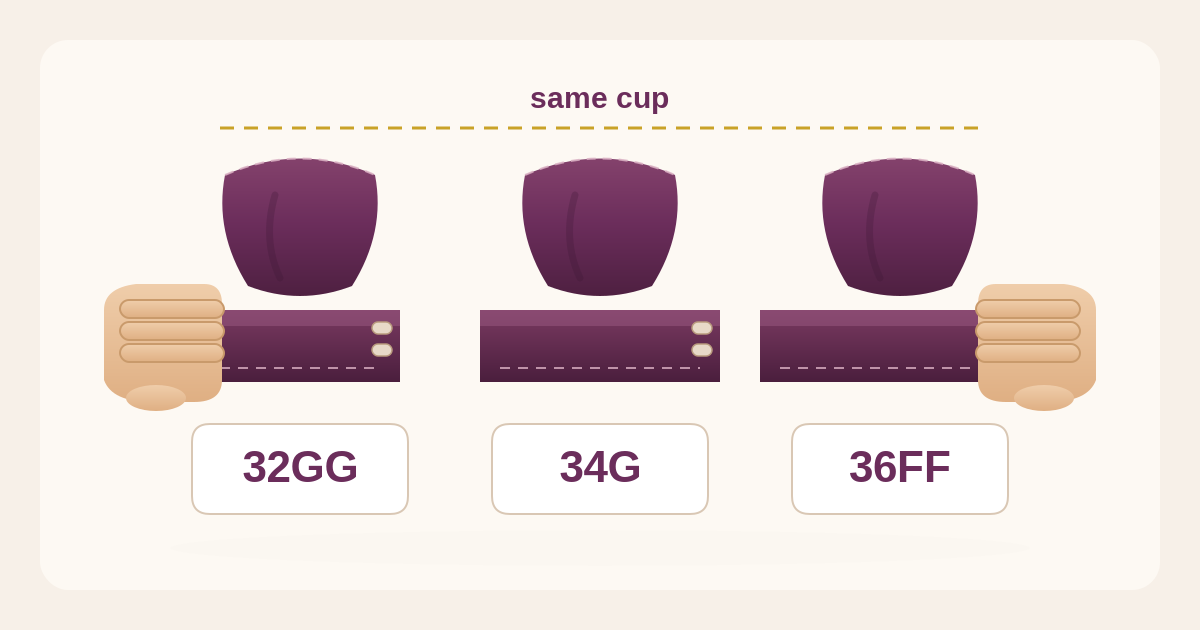
Sister sizes are one of the most useful ideas in bra sizing, and one of the most misunderstood. A sister size is not a different size that happens to be close. It is a deliberate trade: you change the band, and you change the cup letter in the opposite direction, so that the cup capacity stays roughly similar while the frame changes. Used that way, it solves a specific problem. Used any other way, it creates a new one.
The rule is simple. Go up a band, go down a cup. Go down a band, go up a cup. For a UK 34G starting point, the sister sizes are 32GG (smaller band, larger cup letter) and 36FF (larger band, smaller cup letter). The cup letter moves because cup letters are relative to the band: a G cup on a 34 band and a GG cup on a 32 band describe a similar cup capacity on different frames. The letter alone never tells you the capacity — only the band and the cup together do.
Sister sizing is not conversion
The most common confusion is between sister sizing and conversion, and it matters because they answer different questions. Conversion changes the labelling system while keeping the same band and the same capacity: UK 34G becomes US 34I on the common ladder used here. Nothing about the garment changes — only the name on the label. The size converter does this job, and the UK-versus-US worked example follows one label through a shop’s selector to show where it goes wrong.
Sister sizing changes the garment itself: a different band, and therefore a different frame, with the cup letter adjusted to keep capacity similar. UK 34G to UK 36FF is a sister move. UK 34G to US 34I is a conversion. Treating one as the other is how people end up ordering a 36G when they meant 36FF — same band change, but the cup letter was never adjusted, so the capacity changed as well.
What sister sizing cannot fix
A sister size only addresses the band. It cannot fix a cup-shape problem. If the cup is too shallow, too deep, too wide or too narrow for that model, moving to a sister size keeps the same basic cup shape on a different frame, and the shape problem usually travels with it. The same goes for a wire that sits on tissue, straps that will not stay put, or a neckline that cuts in — those are style and shape questions, and a different style is the better next step than a different sister size.
It also cannot fix a measurement problem. If the starting size came from a diagonal tape or a compressed bust measurement, the sister sizes derived from it inherit the same error. In that case, re-measure first using the measuring guide rather than shopping sideways from a doubtful starting point. And a sister size is not a guarantee of fit: “similar capacity” is a property of the sizing system, and any individual garment can still differ in wire width, cup depth or cut.
Capacity lives in the pair, not the letter
The deepest version of the sister-size idea is this: cup capacity is a property of a pair — a band plus a cup letter together — never of a letter on its own. A G on a 34 band, a GG on a 32 band and an FF on a 36 band describe a similar capacity because the letter moves to compensate for the band. The relation is mechanical: go up a band, go down a cup step; go down a band, go up a cup step. Each band step in this system is two inches, and each cup step is one inch of difference, so the compensation is exact in the system even though any individual garment can still vary.
That pair relation is also why the letter alone misleads. A G cup on a 28 band and a G cup on a 44 band are not the same cup in any practical sense — the difference is the same 9 inches in the UK system, but the frame, the cup volume and the garment are all different. Saying “I am a G cup” without the band is like giving a height without a unit: the number is real, but the meaning is missing. Sister sizes make the pair relation visible, because they are the same capacity expressed on different frames. The full run around the site’s worked example shows it: 32GG, 34G and 36FF are one capacity on three frames, and extending the same rule one more step in each direction gives 30H below and 38F above — each step up the band is one step down the cup ladder, and vice versa. The sister sizes tool lays out that run for any starting size, so you do not have to work the ladder by hand.
Sister sizes across systems: convert first, then sister
Sister sizing and conversion compose, but only in one order, and getting the order wrong is a second, subtler version of the classic mistake. Convert first, then sister. If your starting point is UK 34G and you are shopping in the US system, first convert the label on the common ladder — UK 34G becomes US 34I — and only then apply the sister rule inside the US system, using the size converter to check the exact US sister labels rather than guessing them. What you must not do is sister-size in one system and convert in the other in the same step, or convert a sister size as though it were the original: UK 36FF converted carelessly, or a US sister guessed from a UK letter, will drift by a cup step without any sign that it has done so.
The same discipline applies to the DDDD ladder. On HauteFlair’s DDDD ladder, UK 34G reads US 34H, not US 34I — the same 9-inch difference, a different label, as the what-is-a-G-cup guide explains. A sister move taken from the wrong ladder inherits the wrong starting label, and every step after it is wrong too. Name the ladder, convert on that ladder, and only then move to a sister size. Two operations, in that order, each checked separately — that is the whole method, and it is what keeps a sister size precise instead of approximate.
Stock, style and frame: when a sister size helps in a shop
The out-of-stock case deserves a closer look, because it is where sister sizes are most often used well — and most often misused. A sister size is a reasonable substitute to try when your size is unavailable, provided you treat it as a try-on candidate and check it with the same care as the original: band settled and level, cups containing without spilling or gaping, wires flat against the ribcage. The fit checker is the right tool for that check, because it forces the same specific observations you would make for the original size.
But a sister size also changes the frame the cup sits on, and that frame change can matter beyond the band measurement itself. A larger band sits on a wider frame, a smaller band on a narrower one, and the same cup shape can sit differently on each — which is why a sister size that is correct in the system can still feel different on the body, and why “similar capacity” is a property of the sizing system rather than a promise about any individual garment. Wire width, cup depth and cut can all differ by model, and the style finder is the better next step when the shape, rather than the band, is what feels wrong. A sister size solves a band problem; it does not pretend to solve a frame problem that happens to look like one.
The mistakes that turn a sister size into a wrong size
Three mistakes account for most sister-size failures, and all three are worth naming because they look like reasonable shortcuts. The first is ordering the same cup letter on a new band — 36G when you meant 36FF — which changes the capacity as well as the band, so you have changed two things and can no longer tell which one caused the result. The second is stacking operations: converting and sister-sizing in a single mental step, so a labelling change and a frame change get confused and the order ends up a cup step adrift. The third is treating a sister size as an equivalent garment rather than a try-on candidate — ordering it without checking, because the system said the capacity was similar, and then concluding that sister sizing “doesn’t work” when the individual garment differs in wire or depth.
Each mistake has the same cure: change one thing at a time, write down what you changed, and check the result with the fit checker before changing anything else. And if a sister size fails, do not automatically try the next sister further out. Step back to the starting size and ask whether the problem was ever the band at all — if the cups gaped on a settled band, or a wire sat on tissue, the answer was shape or style, and another sister step only moves you further from the right question.
Sister sizes, measurement and the starting point
Finally, sister sizes inherit the quality of the starting size, and that relation closes the loop back to measuring. A sister size derived from a careful measurement — level underbust, fullest bust without compression, recorded in the units actually used, via the measuring guide — is a precise tool. A sister size derived from a diagonal tape, a compressed bust reading, or an averaged figure inherits the error, and shopping sideways from it only multiplies the error across more garments. If your sister sizes keep failing in the same direction, the likeliest explanation is not that sister sizing has failed but that the starting point was wrong. Re-measure first, establish the pair — band plus cup, together, in one system — and only then let the sister rule move you to a neighbouring frame. That order, measurement first and sister move second, is what makes the whole relation trustworthy.
When a sister size is the right move
A sister size earns its place in three situations. First, when the cups feel right but the band does not: a band that rides up points to the smaller-band sister, and a band that digs in points to the larger-band sister, with the cup letter adjusted in each case. Second, when your size is out of stock: a sister size is a reasonable substitute to try, provided you check it with the same care as the original — it is a try-on candidate, not an equivalent garment. Third, when you sit between bands: trying both neighbouring bands, each with its adjusted cup letter, tells you more than trying the same cup letter on two bands, because the cup letter on its own does not hold capacity constant.
The discipline is to change one thing at a time. Change the band, adjust the letter, and check the result with the fit checker before changing anything else. Sister sizes are a precise tool — they work exactly when you use them for the band problem they were designed to solve, and they disappoint exactly when you ask them to solve a different one.