
What Is a G Cup Bra Size?
A G cup is not one fixed size: the letter only means something with a band and a system. Learn why a UK G and a US G differ, how volume changes with band, and how to check the fit.
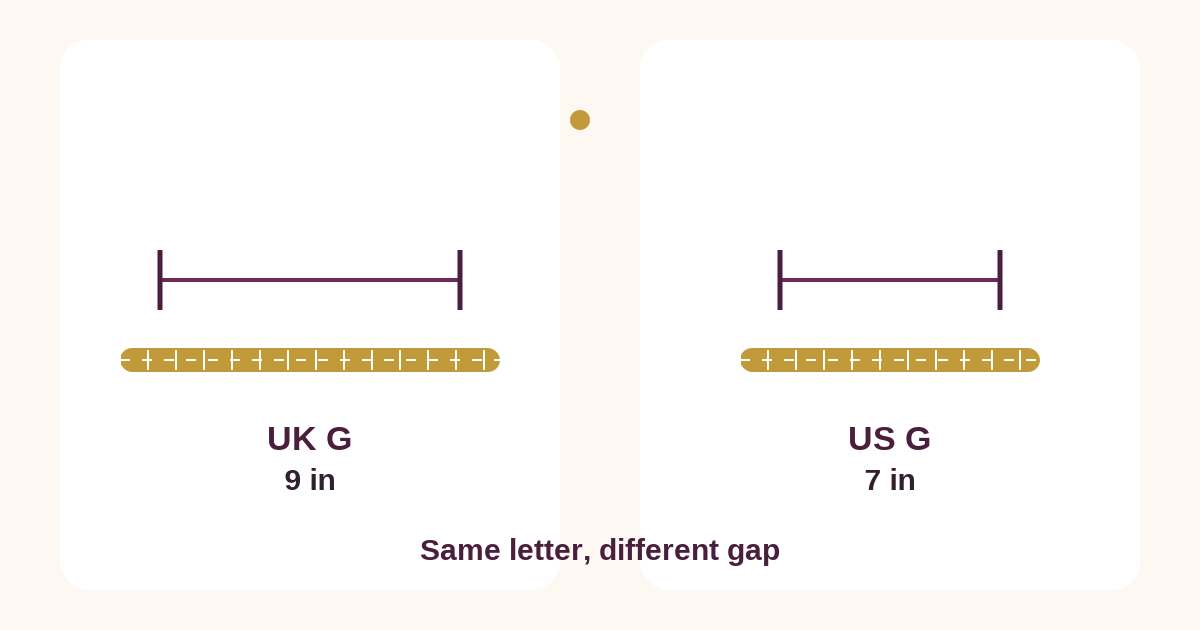
A G cup is a cup position, not a fixed measurement, a body shape, or a size on its own. It describes the difference between bust and underbust: 9 inches on the UK ladder that includes FF, and 7 inches on the common US ladder that does not. The ladders agree through D and split after it, so the same letter can name different volumes — always read band, letter and system together, as in 34G UK: a UK 34G and a US 34G are not the same size, and neither label on its own guarantees a fit.
- A G cup is a cup position, not a fixed size: UK G is a 9-inch bust-minus-band difference on the ladder that includes FF, and US G is a 7-inch difference on the common US ladder.
- UK 34G sister sizes are 32GG and 36FF — the same cup volume on a different band.
- The band drives the volume: a G cup on a 28 band holds far less than a G cup on a 40 band.
- Brands rework construction around G, so check the brand's own chart and the fit — not the letter alone.
- Worked example: a 34-inch underbust with a 43-inch bust is UK 34G, US 34I, EU 75I.
Find your starting size
Start with two measurements. Choose your label system, explore international equivalents and see exactly how the result is calculated.
Watch the tape follow your measurements.
Select a field to highlight that part of the guide. The displayed lengths update as you type; the drawing changes proportion schematically.
- Use the underbust marker to place the lower tape.
- Move to the fullest bust without pulling tight.
- Compare the two lengths, then check your starting sizes below.
Front view: locate the fullest bust and the ribcage directly below the tissue. Tape loops describe the complete circumference.
Place the tape directly below the breast tissue. Keep it level and snug without pain.
An illustrated measuring guide, not a scan of your body. Live lengths are circumferences, not screen widths. The three views explain tape placement; their proportions are schematic.
Your measurements, explained.
Enter both values to see your UK and US starting sizes. The result is not restricted to G cup.
| Difference | UK | US | EU |
|---|---|---|---|
| 7 in | F | G | |
| 8 in | FF | H | |
| 9 in | G | I | I |
The 9-inch or 7-inch question
Some ladders include FF (UK) as a step before G; others skip it. Where FF is a step, G lands at a 9-inch difference. Where the ladder moves from F straight toward G — as in the common US sequence DD, DDD, G — G lands at a 7-inch difference. That is why the same letter can mean two different volumes, and why a US G ordered by a UK G shopper can arrive a full cup (or more) too small. A quick test for the label in front of you: look at the step after DD on that chart. If it is DDD, the chart follows a US-style sequence; if it is E, it follows a UK-style sequence.
The inch difference is the consistent reference; the letter alone is not. And if a brand’s chart disagrees with the chart used here, the brand’s chart wins — it reflects how that garment was actually cut.
Worked example: a 34-inch underbust with a 43-inch bust is UK 34G, US 34I, EU 75I. Conversely, a US 34G corresponds to a UK 34F on the ladders used here. On a US chart that inserts DDDD after DDD, the same 9-inch UK 34G reads US 34H instead — the difference is the same, only the label differs. To see where G sits beside its neighbours, Compare G with F, FF, GG and H.
How G cup volume changes by band
A G cup on a 28 band holds a smaller volume than a G cup on a 38 band, because the letter is a ratio to the band, not a fixed cup size — 28G and 40G are very different volumes despite sharing the letter. Sister sizes keep nominal volume close while changing band: go down a band and up a cup, or up a band and down a cup. Worked pairs from a starting size are in the sister sizes guide.
No single millilitre or weight figure is given here, because competitor figures for “a G cup” disagree with each other — different ladders, different bands, no method shown — so publishing one number would be false precision. There is no universal G cup body, fruit equivalent, breast weight or volume in millilitres.
- UK 32G sisters: 30GG and 34FF
- UK 34G sisters: 32GG and 36FF
- UK 36G sisters: 34GG and 38FF
- UK 38G sisters: 36GG and 40FF
Why brands rework patterns at G
Some brands build their core patterns around smaller cup ranges and rework construction at around G, while specialist fuller-bust brands grade from a fuller starting point. That is one reason the same letter can fit differently from brand to brand even when the inch difference matches — so check the brand’s chart first, then shape and wire width, before concluding the size is wrong. This is a brand-pattern observation, not a universal rule about every brand.
The 7-point G cup fit check
Settle tissue into the cups first — swoop and scoop — then work through the checks in band-first order before judging a fit. The step-by-step fit checker turns each of these checks into a next comparison.
- Band: level and snug on the loosest hook
- Gore: flat against the sternum without floating
- Cups: contain tissue without spillage or gaping
- Wire: follows the breast root without poking
- Straps: stay up without digging
- Lift: comes from the band, not the straps
- Comfort: holds through a normal day, not just the first try-on
G cup fit problems and what to try next
Use the symptom to decide the next comparison, then confirm it in a try-on.
- Band rides up → band too loose → try a sister size down in band (for example UK 34G → 32GG), cup up to keep volume close
- Gore floats → cup too small, or band too big → try a cup up, or a band down with a cup up
- Spillage over the top or sides → cup too small → try a cup up
- Cups gape → cup too large, or wrong shape/wire width → try a cup down, or a different construction; check shape with the shape-finder
- Straps dig → usually the band is too loose, not a strap problem → check band first before tightening straps
- Straps slip → strap placement, worn elastic, or band fit → adjust, replace, or re-check band
- Wire pokes → wrong wire width or a pattern not graded for a fuller bust → try a different wire width or construction
- A new brand’s G arrives a cup too small → check that brand’s ladder for FF/DDDD first; the brand’s chart wins
Keep exploring
Start with the homepage calculator, then check sister sizes, work through fit problems, match cup shape, or compare brand charts. For the UK/US distinction in a real order, read the UK 34G on a US storefront example and why two measurements can differ.
Common questions
Is a G cup the same as a GG?
Is a US DDD the same as a UK G?
Is a G cup the same as an H?
Is G big?
What sits between F and G?
Why does my G fit differently by brand?
Sources & method
These named references informed the chart or fit guidance. Find publisher details and source locations in our source register. Worked examples use our documented independent method; they are not product tests or fit guarantees.
Found a chart mismatch or unclear explanation? Tell us which page and sizing system.